SSDN Technologies
09 January 2026
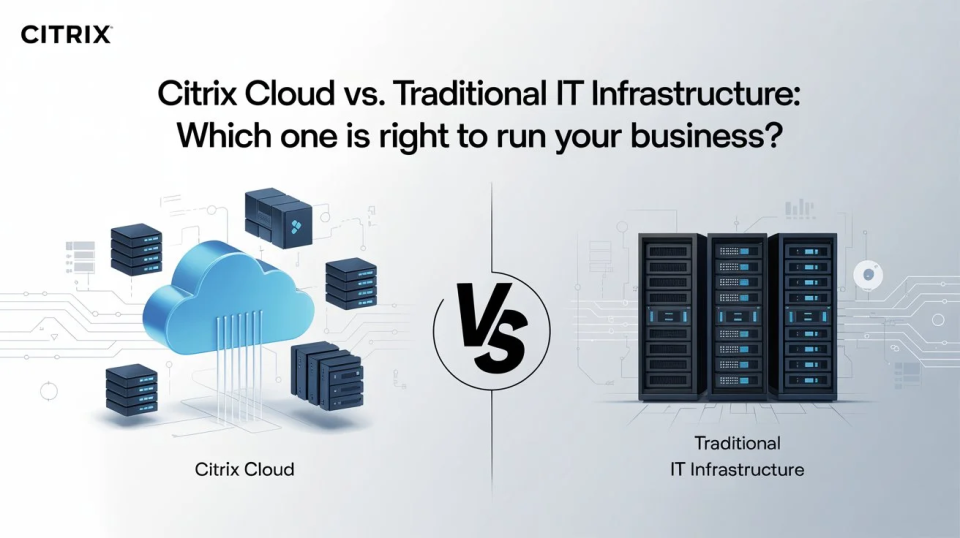
In today’s digital-first world, organisations are increasingly faced with a critical decision: should they continue using traditional on-premises IT infrastructure or transition to cloud-based solutions? This choice can be particularly challenging for businesses that rely on legacy systems or operate within complex IT environments.
As cloud technologies mature, platforms like Citrix Cloud have emerged as powerful alternatives, offering scalability, flexibility, and cost efficiency for delivering virtual desktops, applications, and secure data access. However, traditional IT infrastructure remains relevant for certain organisations, especially those with strict compliance needs, legacy dependencies, or limited internet connectivity.
Citrix Cloud is a cloud-based platform designed to simplify the delivery and management of virtual desktops, applications, and IT services. It enables organisations to leverage Citrix solutions such as Citrix Virtual Apps and Desktops, Citrix ADC, and Citrix Endpoint Management without the need to manage the underlying infrastructure.
Citrix fully manages the control plane, reducing complexity while ensuring high availability, security, and scalability. The platform supports hybrid and multi-cloud deployments, allowing businesses to run workloads on public cloud providers like Microsoft Azure, AWS, or Google Cloud while still integrating with on-premises systems when required.
Traditional IT infrastructure refers to on-premises hardware and software systems used to run business operations. This includes physical servers, storage systems, networking devices, data centres, and end-user workstations.
Organisations relying on traditional IT must manage the entire infrastructure lifecycle—from procurement and installation to maintenance, upgrades, security, and compliance. This approach typically requires dedicated IT teams to ensure uninterrupted operations and system reliability.
To make an informed decision, it’s essential to compare both approaches across critical business and IT parameters.
One of the biggest advantages of Citrix Cloud is cost efficiency. It shifts IT spending from a capital expenditure (CapEx) model to an operational expenditure (OpEx) model. Businesses benefit from:
Traditional IT environments typically involve higher upfront and ongoing costs, including:
Scalability is one of the strongest advantages of Citrix Cloud. Organisations can scale resources up or down instantly in response to demand.
Scaling traditional infrastructure is often slow and costly.
Citrix Cloud enables secure, anytime access to applications and desktops from almost any device using Citrix Workspace.
Traditional IT environments are often less flexible.
With on-premises IT, security responsibility lies entirely with the organisation.
This allows IT staff to focus on strategic initiatives rather than routine maintenance.
Choosing between Citrix Cloud and Traditional IT Infrastructure depends on your organisation’s size, budget, scalability needs, and long-term IT strategy. Citrix Cloud is an excellent choice for businesses seeking agility, cost optimisation, remote accessibility, and reduced management overhead. Traditional IT infrastructure may still suit organisations with legacy systems, strict regulatory requirements, or complete control needs.
At Best IT Training Company, we help professionals and enterprises understand modern IT solutions like Citrix Cloud and make informed technology decisions. With the right strategy, businesses can optimise performance, security, and cost—ensuring long-term success in an evolving digital landscape.