SSDN Technologies
25 February 2026
In today’s multi-cloud world, organisations are no longer relying on a single cloud platform. Businesses run workloads across on-premises data centres, hybrid environments, and multiple public clouds. To manage this complexity, cloud providers offer advanced management solutions. If you are planning to upskill through a Microsoft Azure Course, understanding the difference between Azure Arc and AWS becomes essential for building a strong cloud foundation.
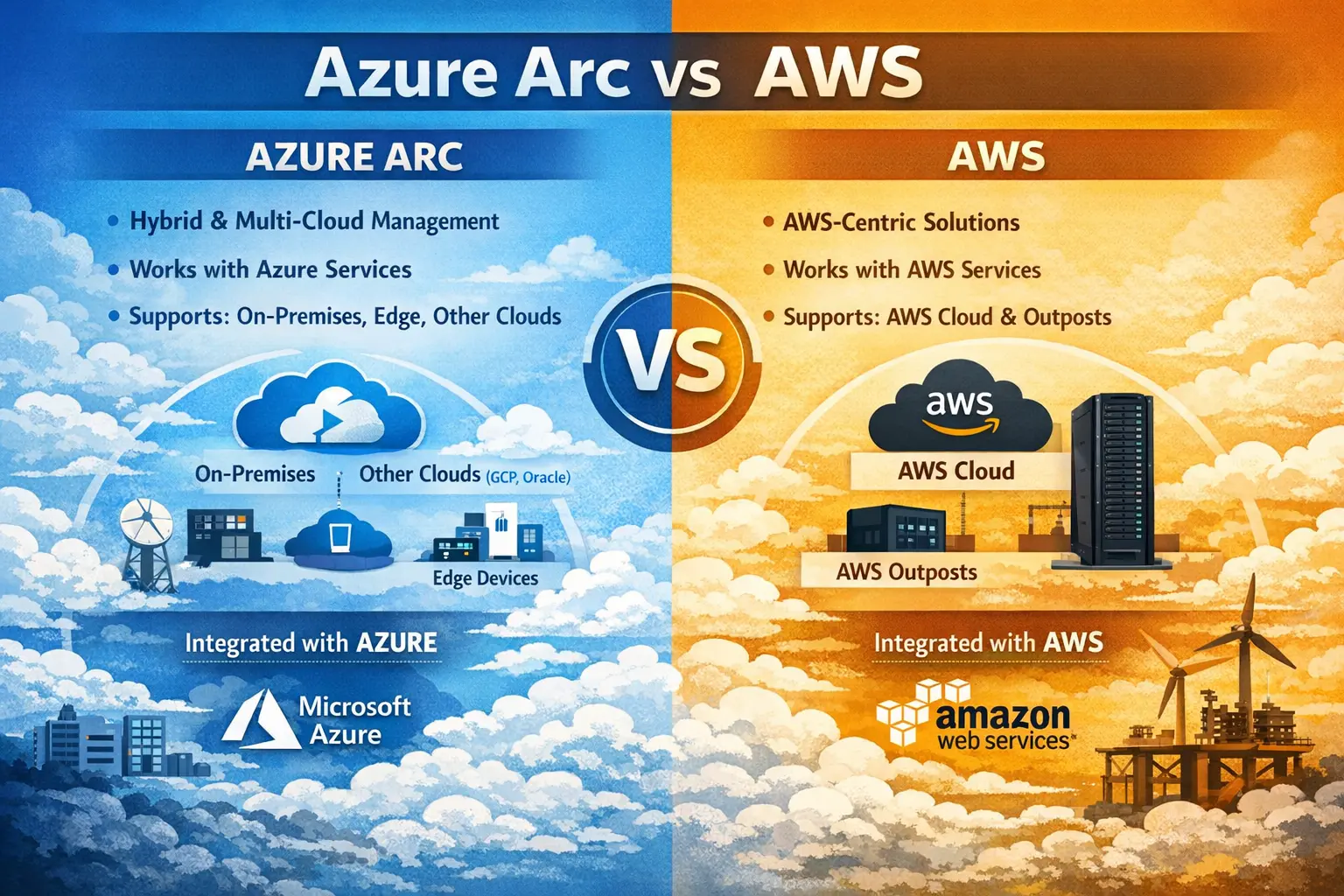
Azure Arc is a hybrid and multi-cloud management platform developed by Microsoft. It allows organisations to manage servers, Kubernetes clusters, and applications running across on-premises, edge, and other cloud environments directly from the Azure control plane. Simply put, Azure Arc extends Azure management capabilities beyond the Azure data centres.
With Azure Arc, businesses can apply Azure policies, security configurations, and governance tools across different infrastructures. This centralised approach helps companies maintain compliance, monitor resources, and streamline operations from a single dashboard.
Azure Arc is particularly useful for enterprises that already rely heavily on Microsoft technologies and want consistent management across distributed systems.
Amazon Web Services (AWS) is the world’s leading cloud computing platform, offering a broad range of services including computing power, storage, networking, AI, analytics, and security. AWS primarily focuses on delivering scalable and flexible cloud infrastructure within its own ecosystem.
AWS provides services such as EC2, S3, RDS, and Lambda, enabling businesses to deploy applications quickly and scale as needed. While AWS does offer hybrid solutions like AWS Outposts, its main strength lies in its vast and mature cloud-native infrastructure.
If someone enrols in an AWS Course, they typically learn about deploying and managing workloads within the AWS ecosystem rather than extending management across other cloud providers.
The primary difference between Azure Arc and AWS lies in their approach.
Azure Arc does not replace Azure itself; instead, it extends Azure management tools to external environments. AWS, on the other hand, focuses on providing services within its own cloud infrastructure.
Organisations that operate in multi-cloud or hybrid environments often prefer Azure Arc for unified governance. Meanwhile, companies that rely fully on a single cloud provider often choose AWS for its depth of services and global reach.
Azure Arc allows centralised governance across multiple platforms. IT teams can enforce security policies, compliance rules, and monitoring standards uniformly across environments. This is especially beneficial for enterprises dealing with regulatory requirements.
AWS provides strong governance tools within its own environment, such as IAM (Identity and Access Management) and AWS Organizations. However, its cross-cloud management capabilities are not as extensive as Azure Arc’s unified approach.
When learning from a Best IT Training Company, students often compare how Azure Arc simplifies multi-cloud management while AWS strengthens cloud-native deployments.
Azure Arc works with:
This makes it ideal for companies that cannot migrate everything to a single cloud due to cost, legacy systems, or compliance needs.
AWS, in contrast, encourages businesses to build directly within its infrastructure. Although hybrid options exist, AWS is most powerful when workloads are fully integrated into its ecosystem.
Therefore, Azure Arc focuses on management flexibility, whereas AWS focuses on infrastructure scalability and service diversity.
Security is a top priority for both platforms, but the implementation differs.
Azure Arc integrates Azure Security Centre and policy management across multiple environments. This ensures consistent security standards regardless of where the workload resides.
AWS provides robust security services within its cloud, including encryption, monitoring, and access control tools. However, cross-platform security governance requires additional configurations.
Professionals associated with SSDN Technologies often emphasise understanding both platforms’ security architectures to make informed deployment decisions.
Azure Arc pricing is based on the Azure services you enable for managed resources. Costs depend on monitoring, security, and policy tools applied to connected systems.
AWS pricing follows a pay-as-you-go model for compute, storage, and services used within its cloud. It can be highly cost-effective for scalable applications but may require careful optimisation to avoid overspending.
Choosing between Azure Arc and AWS depends largely on business requirements rather than price alone.
The right choice depends on your organisation’s infrastructure strategy:
For IT professionals, learning both platforms can significantly enhance career opportunities. Understanding hybrid cloud concepts alongside cloud-native architectures makes you more versatile in the job market.
Azure Arc and AWS serve different but equally important purposes in modern cloud computing. Azure Arc extends management capabilities across diverse environments, making it a powerful hybrid solution. AWS provides a comprehensive cloud ecosystem designed for scalable, high-performance applications.
Instead of viewing them as direct competitors, it’s better to see them as solutions designed for different architectural strategies. Organisations focused on centralised multi-cloud governance often lean toward Azure Arc, while those seeking powerful native cloud infrastructure prefer AWS.